

When it comes to sewage management, non-clog sewage pumps play a crucial role in ensuring efficient and hassle-free operations. Among these pumps, there are two main types: submersible and non-submersible non-clog sewage pumps. Understanding the differences between these two types is essential for making an informed decision when selecting the right pump for your specific needs. As a non-clog sewage pump supplier, I am here to shed light on these differences and help you navigate through the selection process.
Operational Principle
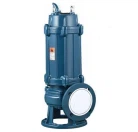
The most fundamental difference between submersible and non-submersible non-clog sewage pumps lies in their operational principle. A submersible non-clog sewage pump is designed to be fully submerged in the sewage or wastewater it is pumping. This design allows the pump to use the surrounding liquid to cool the motor, which is typically enclosed in a watertight casing. The pump is directly immersed in the sewage, and its impeller creates a centrifugal force that pushes the sewage through the pump and into the discharge pipe.
On the other hand, a non-submersible non-clog sewage pump is installed above the sewage level. It uses suction to draw the sewage from the pit or tank into the pump. The motor of a non-submersible pump is not designed to be in contact with water, so it is located outside the sewage area. This type of pump requires a priming process to remove air from the suction line and create a vacuum that allows the sewage to be drawn into the pump.
Installation and Maintenance
Installation of submersible and non-submersible non-clog sewage pumps also differs significantly. Submersible pumps are relatively easy to install, as they can be simply lowered into the sewage pit or tank. They do not require a separate pump house or platform, which can save space and installation costs. However, accessing a submersible pump for maintenance can be more challenging, as it needs to be lifted out of the sewage. This may require specialized equipment and can be time-consuming.
Non-submersible pumps, on the other hand, are installed above the ground, which makes them more accessible for maintenance. They can be easily inspected, repaired, or replaced without the need to drain the sewage pit. However, the installation of a non-submersible pump may require a more complex setup, including a suction line, check valve, and priming system. This can increase the initial installation cost and the overall footprint of the pumping system.

Performance and Efficiency
In terms of performance, submersible non-clog sewage pumps are generally more efficient than non-submersible pumps. Since they are directly immersed in the sewage, they can pump the liquid with less energy loss. The submersible design also allows for a more compact and powerful motor, which can handle higher flow rates and pressures. Additionally, submersible pumps are less prone to cavitation, a phenomenon that can cause damage to the pump impeller and reduce its efficiency.
Non-submersible pumps, while less efficient in some aspects, have their own advantages. They can be used in applications where the sewage level fluctuates significantly, as they do not need to be submerged. Non-submersible pumps are also more suitable for pumping sewage with a high solid content, as the suction design allows for better control of the solids entering the pump.
Applications
The choice between a submersible and a non-submersible non-clog sewage pump also depends on the specific application. Submersible pumps are commonly used in residential, commercial, and industrial applications where the sewage needs to be pumped from a basement, septic tank, or wastewater treatment plant. They are ideal for applications where space is limited and a quiet operation is required.
Non-submersible pumps are often used in larger-scale applications, such as municipal sewage systems, industrial wastewater treatment plants, and flood control systems. They are suitable for applications where the sewage needs to be pumped over long distances or to a higher elevation. Non-submersible pumps can also be used in applications where the sewage contains large solids or abrasive materials.
Our Product Range
As a non-clog sewage pump supplier, we offer a wide range of submersible and non-submersible non-clog sewage pumps to meet the diverse needs of our customers. Our Self-Priming Sewage Pump is a popular choice for applications where a reliable and efficient pumping solution is required. It is designed to automatically prime itself, eliminating the need for manual priming.
Our Pipeline Non-Clogging Sewage Pump is suitable for pumping sewage through pipelines over long distances. It features a non-clogging design that can handle solids and fibrous materials without clogging.
For applications where a vertical installation is required, our Upright Non-Clogging Sewage Pump is an excellent choice. It is designed to be installed vertically, saving space and providing a compact pumping solution.
Conclusion
In conclusion, the choice between a submersible and a non-submersible non-clog sewage pump depends on several factors, including the application, installation requirements, performance needs, and budget. Submersible pumps offer advantages such as easy installation, high efficiency, and quiet operation, while non-submersible pumps provide better accessibility for maintenance and are more suitable for larger-scale applications.
As a non-clog sewage pump supplier, we are committed to providing our customers with high-quality pumps and professional advice. If you are in the market for a non-clog sewage pump, we encourage you to contact us to discuss your specific needs. Our team of experts will be happy to help you select the right pump for your application and provide you with a competitive quote.
References
- "Pump Handbook" by Igor J. Karassik, Joseph P. Messina, Paul Cooper, and Charles C. Heald.
- "Sewage Pumping and Treatment" by the Water Environment Federation.
- Industry standards and guidelines for sewage pump design and installation.